Better store pages get more reviews
Every dot is one game. Up means a better page score from Jev. Right means more Steam reviews, each step ten times more. Hover or tap a dot to see the game.
The sample includes more successful games than Steam has, so that every level is covered. The charts below are weighted back to represent all 85,152 games.
Ignored games have the weakest store pages
How page scores are spread out within each group. The ignored games sit to the left, the hits to the right.
A top-5% page is 14x more likely to be a hit
Games grouped by where their page score ranks on Steam. For each group, the red bar is the share that got ignored and the green bar the share that became a hit with 1,000+ reviews.
The great-page games that got ignored did almost no distribution: 1 in 34 had a video by another creator
A few games with a page score of 75 or more still got ignored. I took all 34 of them and 34 games with pages just as good that took off, and had a second AI (Claude Haiku) search the web for each one: official site, social accounts, press, videos by other creators, community threads. Store and database pages don't count. Hover a cover for what it found; click to open the game.
What the search found for the 34 ignored games
Ignored games link fewer social accounts: 46% link none, and only 16% link four or more (hits: 34%)
All 1,762 games with a page score of 75 or more, weighted to Steam, split by outcome. The count is what each store page itself lists.
Great pages that link 4+ social accounts become hits 66% of the time, vs 50% with none
One caveat: part of the presence of the games that took off came after their success — popular games get videos and articles written about them, so this cannot show that marketing causes success. The other side is clear, though: almost none of the ignored games got covered before, during or after launch.
Try it yourself: can you tell an ignored game from a hit by its page?
24 random games from each level, drawn in their real proportions. A red outline means the game got ignored. Click any game to open it on Steam.
Once you know the page score, what else matters?
A machine-learning model predicted every game's reviews from its page (Jev's ratings, in blue) and from facts about the game (in white). These are its Shapley values: each dot is a game, and the further right it sits, the more that feature pushed its reviews up. Red dots are games with a high value for that feature.
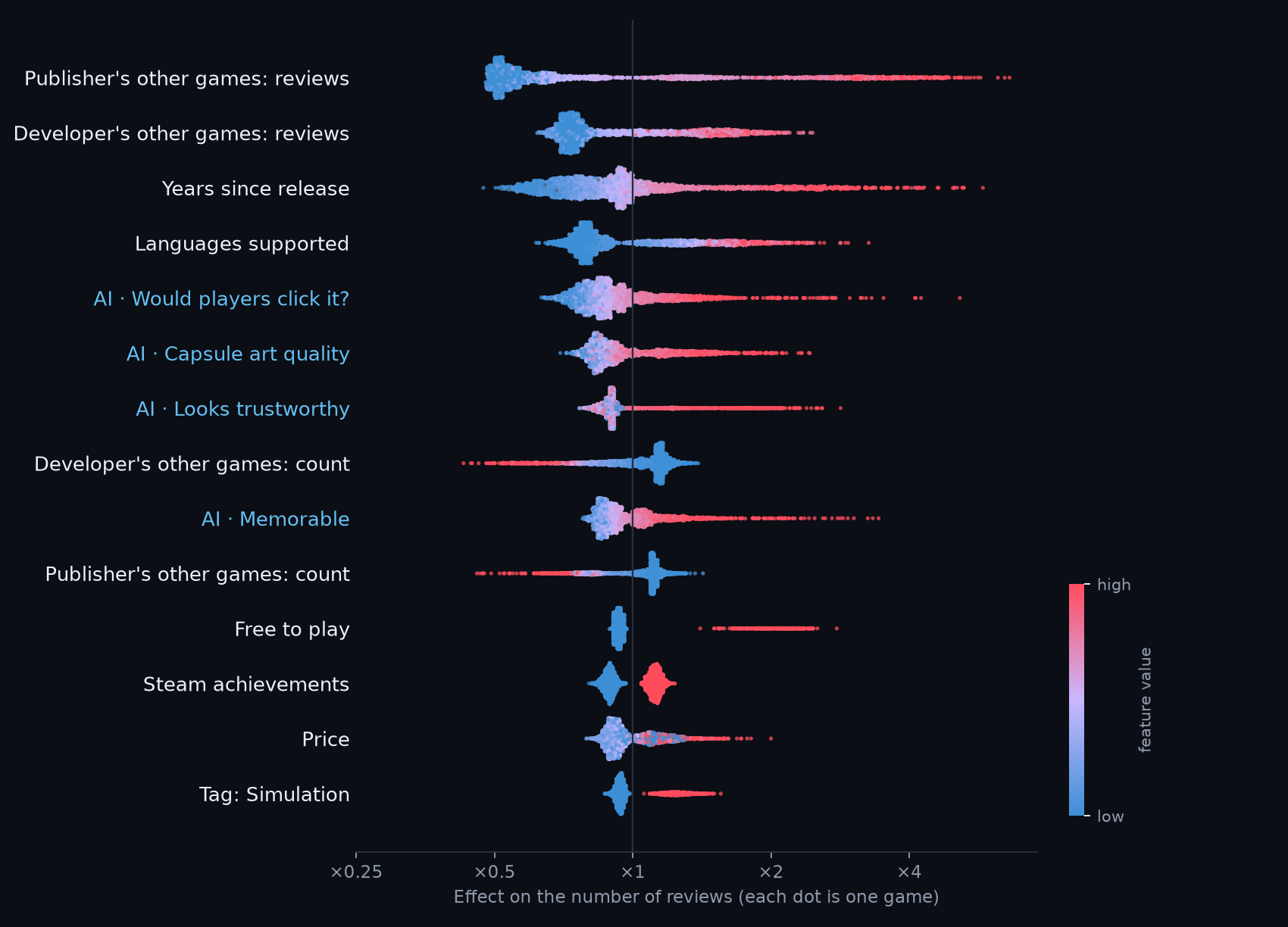
Who is behind the game matters most: how many reviews the developer's and publisher's other games have. Right after come the page signals: whether players would click it, capsule art quality, and whether it looks trustworthy. Together, the page ratings make up about a third of what the model uses.
The 46 questions Jev answered about every page
Every page got exactly these questions, word for word. header is the capsule image, screenshots the four screenshots, short_description and description the store texts. The page score is the average of the 29 ratings marked "counts toward the page score". Jev never saw any review count.
Show the 46 questions
Every request also started with this instruction:
This is the Steam store page of a video game.headeris the capsule image shown in store lists,screenshotsare its store screenshots,short_descriptionanddescriptionare its store texts. Judge presentation craft only. Ignore awards, press quotes, review scores and sales claims; they must not raise any rating.
The capsule image 11
Rate the overall quality of
rating · counts toward the page score: Amateur or placeholder → Weak, clearly low effort → Competent but generic → Good, professional → Top-tier key artheaderas capsule art for a game store.Is
yes / noheaderjust an in-game screenshot with a title on top, rather than dedicated key art?Rate the color and contrast of
rating · counts toward the page score: Dull, muddy or garish → Weak → Acceptable → Appealing → Strikingheader.Rate the typography / logo design of the title in
rating · counts toward the page score: No title or default font → Basic → Decent → Designed logo → Iconic, professional logoheader.Among dozens of capsules in a Steam list, how much would
rating · counts toward the page score: Invisible → Barely → Somewhat → Clearly → Immediately grabs attentionheaderstand out?What is the art style of
pick one: Pixel art · 3D render · Hand-drawn or painted illustration · Anime / manga style · Photograph or live action · Mostly text or logo on a plain background · Otherheader?How readable would the title in
rating · counts toward the page score: Unreadable or no title → Hard to read → Readable with effort → Readable → Instantly readableheaderbe when shown as a small thumbnail (about 230x90 px)?How quickly can you tell the genre of the game from
rating · counts toward the page score: Impossible to tell → Hard to tell → With some effort → Quickly → Instantlyheaderalone?Does
yes / noheaderprominently feature a character or creature?What is the dominant mood of
pick one: Dark or horror · Epic or heroic · Cute or cozy · Bright and fun · Calm or melancholic · Neutral, no clear moodheader?How well does
rating · counts toward the page score: Misleading, a different game → Loosely → Somewhat → Well → Perfectlyheadermatch the game actually shown inscreenshots?
The screenshots 11
Rate the visual quality and polish of the game shown in
rating · counts toward the page score: Very crude → Rough → Average → Polished → Stunningscreenshots.Do
yes / noscreenshotsmostly show actual gameplay (not menus, concept art, logos or text slides)?How varied are
rating · counts toward the page score: All nearly identical → Little variety → Some variety → Varied → Very varied, shows the whole gamescreenshots(different scenes, mechanics, situations)?From
rating · counts toward the page score: No idea → Vague → Roughly → Clearly → Instantly obviousscreenshotsalone, how well can you understand what the player actually does?How clean and readable is the in-game UI in
rating · counts toward the page score: Unreadable or broken → Messy → Acceptable → Clean → Excellentscreenshots?How consistent is the art direction across
rating · counts toward the page score: Mismatched assets → Inconsistent → Mostly consistent → Consistent → Strong unified stylescreenshots?What production scale do
pick one: Hobbyist or student project · Low-budget indie · Polished indie · AA studio · AAA studioscreenshotssuggest?What kind of graphics does the game in
pick one: Pixel art · 2D illustrated / hand-drawn · Low-poly 3D · Stylized 3D · Realistic 3D · Mostly text or UI · Visual novelscreenshotshave?How original are the art assets in
rating · counts toward the page score: Obvious generic store-bought assets → Mostly generic → Mixed → Mostly custom → Fully custom and distinctivescreenshots?How technically clean are the images in
rating · counts toward the page score: Very low resolution or broken → Poor → Acceptable → Clean → Crisp and high qualityscreenshots(resolution, no stretching, no compression artifacts)?Do
yes / noscreenshotsshow placeholder, unfinished or debug graphics?
The description 13
How well does the start of
rating · counts toward the page score: No hook, confusing → Weak → Okay → Strong → Irresistibleshort_descriptionanddescriptionhook the reader?After reading
rating · counts toward the page score: No idea → Vague → Roughly clear → Clear → Crystal clearshort_descriptionanddescription, how clear is what you actually do in the game?How clear and distinctive is what makes this game different from others, per
rating · counts toward the page score: Nothing distinctive → Generic → Somewhat distinctive → Clear unique angle → Very original and well solddescription?Rate the writing quality of
rating · counts toward the page score: Broken, many errors → Poor → Acceptable → Good → Professional copywritingdescription(grammar, fluency, concision).Rate the structure and formatting of
rating · counts toward the page score: Wall of text or almost empty → Poor → Acceptable → Well structured → Excellentdescription(headings, short paragraphs, lists).Does
yes / nodescriptioninclude a clear list of features?How generic or cliché is
rating · counts toward the page score: Pure cliché → Mostly generic → Mixed → Mostly fresh → Fresh and specificdescription?Does
yes / nodescriptionmention awards, press quotes, review scores or famous previous games?What is the tone of
pick one: Hype marketing · Plain and informative · Personal / developer voice · Humorous · Story or lore heavy · Almost nothing writtendescription?How concrete is
rating · counts toward the page score: Only vague adjectives → Mostly vague → Mixed → Mostly concrete → Very concretedescription(named mechanics, numbers, specifics) versus vague adjectives?How well does
rating · counts toward the page score: Not at all → Weakly → Somewhat → Well → Very stronglydescriptionevoke a feeling or a fantasy the player wants?Does
yes / nodescriptionclearly name the game's genre?Does the first sentence of
yes / noshort_descriptionsay what kind of game it is?
The whole page 11
Rate the overall quality of this store page as a whole (images and text).
rating · counts toward the page score: Amateur → Weak → Average → Professional → OutstandingHow well do
rating · counts toward the page score: Contradictory → Loose → Okay → Coherent → Perfectly alignedheader,screenshotsanddescriptionfit together as one consistent pitch?How likely would a typical Steam user be to click on and wishlist this game based on this page?
rating · counts toward the page score: Very unlikely → Unlikely → Maybe → Likely → Very likelyWho most likely made this game, judging by the page?
pick one: A solo hobbyist · A dedicated solo developer · A small indie team · An established indie studio · A large AA/AAA studioHow broad is this game's likely audience?
rating: Tiny niche → Niche → Moderate → Broad → Mass marketHow legitimate and trustworthy does this game look (versus a cash grab or scam)?
rating · counts toward the page score: Looks like a scam → Doubtful → Neutral → Trustworthy → Clearly a serious productHow original is the game's concept?
rating · counts toward the page score: Pure clone → Derivative → Some twist → Original → Highly originalHow memorable is this game after seeing the page once?
rating · counts toward the page score: Forgettable → Barely → Somewhat → Memorable → UnforgettableDo you recognize this specific game as a well-known title?
yes / noWithin 3 seconds of seeing
rating · counts toward the page score: Not at all → Barely → Partly → Well → Completelyheaderandshort_description, how well would a user grasp the game's concept?How crowded is this game's genre on Steam?
rating: Almost no competition → Little → Moderate → Crowded → Extremely saturated
How it was done
I started from a list of 85,152 Steam games and their review counts, from SteamSpy. I picked 30,924 of them so that every level of success is covered, from zero reviews to millions, and weighted them back so the numbers represent all of Steam.
For each game I took what a player sees on its store page: the capsule image, four screenshots and the description, from Steam's store API. An AI model, Jev by TypeSafe, answered the 46 questions above about each page. Asked the same questions twice, it gave practically the same answers (r = 0.99). On 240 pages that I rated blind myself, it agreed with me on which page was better 7 to 8 times out of 10.
Steam keeps sales private, so success is measured in reviews. One review is roughly 30 to 60 copies sold. "Ignored" means fewer than 10 reviews.
For the web-presence section, Claude Haiku (a small model from Anthropic) web-searched 68 of these games: every ignored game with a page score of 75 or more released at least a year earlier (34), plus 34 equally good pages that ended up with 1,000 to 30,000 reviews, picked at random as a control. Each search looked for an official site, social accounts, press coverage, videos by other creators and community threads, with the same questions every time. Every claim on that section links to what the search actually found.