Last weekend I attended to my first in-person hackathon event and it was an amazing experience. On friday we had a 4h introduction to the problem statement. The hackathon'
s purpose was to improve urban movility using data and technology. It was intended to be
more of an open ended hackathon to brainstorm ideas rather than a fixed exercise to maximize a
certain metric given a dataset. The speaker's level was very high and they did a great job.
During the introduction, they put a lot of emphasis on trying to come up with a novel solution
that could potentially solve a problem. Thats why we spent the rest of the day thinking about
how we would approach the problem. Just before the day had finished, we came up with a
great idea.
Saturday's workday was much more intense. We started at 8:00 am and finished at 21:00🤯 (13h
nonstop!!), barely having any breaks, just to eat. One thing I want to highlight is how
productive we were during those hours, and the great time management we had. We did'nt miss a
single minute of work and achieved all the important milestones at the right times.

Our proposed solution was Santan'next. Santan'next is based on using AI agents
that will browse the web to identify relevant and summarize events that could generate an
unusual increase in the movement of people in the city. This summary would be handed to two
types of stakeholders:
Companies:
So they can make decisions on how to address the increase in traffic (e.g., adding discounts
for carsharing or electric bikes, or increasing public transport frequency).
Users:
They will have an interface displaying relevant events and the discounts generated by
companies:
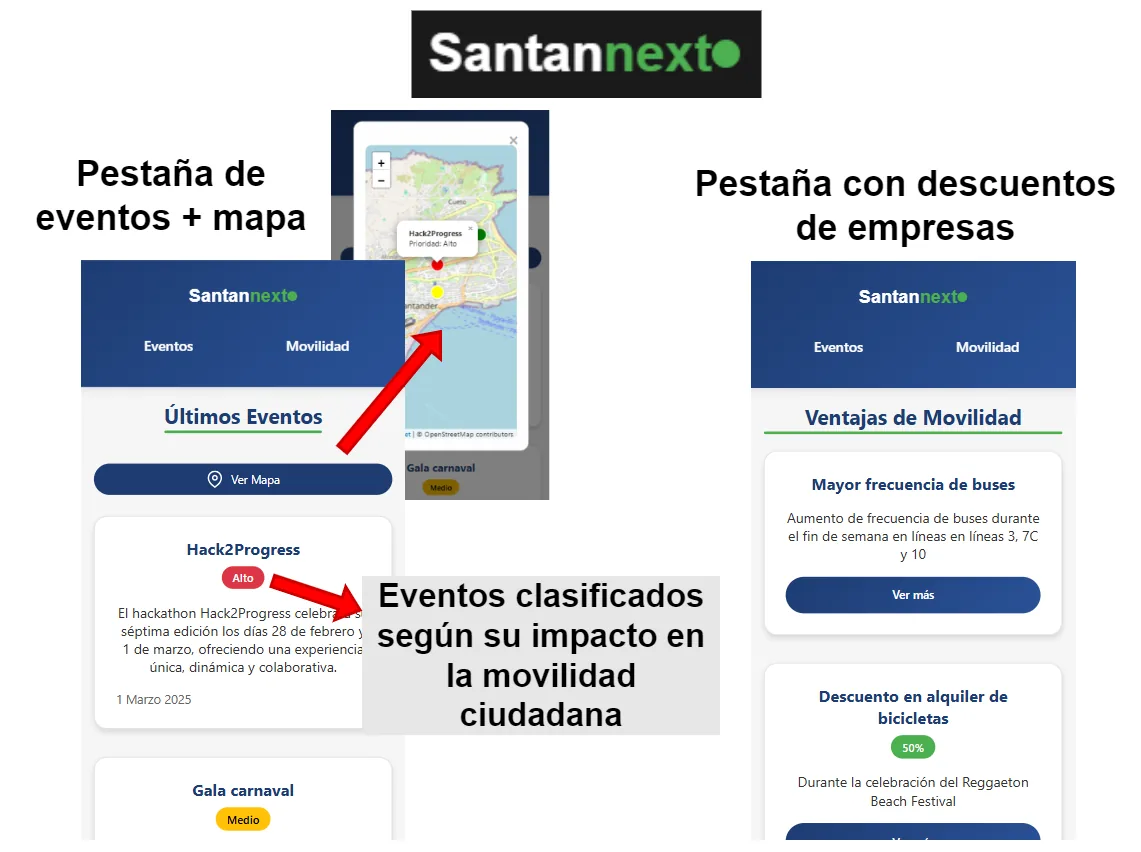
More info about the project in our GitHub repo: here
We thought it was a great idea because it was a never seen, original application of genAI that
could solve a real problem! Usually when we think of genAI we can just think about chatbots or
slop image generators.
We managed to create a prototype of the user's application and a nice presentation to motivate
our solution (in spanish).
However, despite the efforts, we didn't manage to win :(. But still, we are very happy and proud
about our work so it's not a big deal.
Looking back, here's what we did good and what we could have improved:
What we did well:
-
We spent around 3-5% of our time coding:
It was a one day hackathon, so we decided it was better to have a polished
product with a neat presentation to convince the judges.
It turned out to be the best thing we could have done, as at no point they asked us to
show our code or what we achieved in those terms.
-
Everyone worked efficiently:
It was not the case that some people in the team were not contributing or lost, not
knowing what to work on. I mainly worked on the presentation and (small) backend.
Another two teammates mainly focused on the users application, and another one worked on
the branding and looks of the application.
What we could have improved:
-
The message was not clear during the presentation:
The presentation was 5 minutes long, and I feel we did not convey the message clearly. We
went through the slides very fast which led to moments where what we were showing could
not be explained and that probably confused the audience. Especially with the diagrams.
For the next time, we will condense all the information instead of trying to cover all
the aspects. In case the audience has any questions, they can ask. But what we add to
the presentation, needs to be clear.
-
Picking a more generalist topic:
I think our idea caught off guard many people, as it was very different to most of other
teams ideas. Many of them were like "having public transport cards in your phone
device", "Improving last mile delivery" (Winner team), "Adding walkable tiles that
create energy off people walking in the streets". However, creating web browsing agents
to identify important events was not something they expected IMHO.